Cultivating Hope for Caregivers
-
Congratulations to the California START Golden Gate team for presenting the winning research poster at the virtual 2026 START National Training Institute! All START teams are invited to present their research at SNTI to showcase how they are demonstrating the values of the START Model in their communities, with support and guidance from the National Center for START Services®.
This poster stood out because it framed hope as a skill that can be developed over time (rather than a fixed trait), even in the context of ongoing challenges, according to Andrea Palmieri, NCSS Director of Research and Quality Assurance, and member of the SNTI 2026 poster judging panel.
"This intervention reflects a thoughtful integration of positive psychology principles with the realities of crisis-driven caregiving work," Palmieri said. "Overall, this work reinforces the importance of supporting caregiver well-being not as an adjunct to crisis services, but as a central component of effective engagement and sustained support."
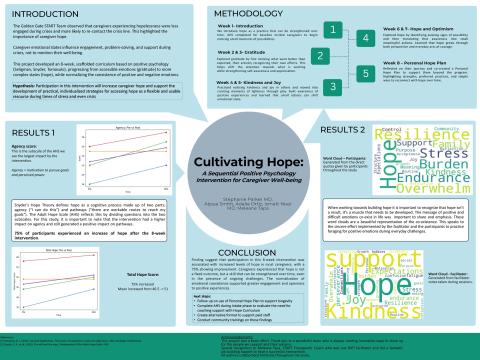
The contents of the poster are reproduced below in an accessible format.
Cultivating Hope: A Sequential Positive Psychology Intervention for Caregiver Well-being
By CA START Golden Gate
Stephanie Parker, MD; Alyssa Smith; Adalia Ortiz; Ismatt Niazi, MD; Meleane Tapa
Introduction
The Golden Gate START Team observed that caregivers experiencing hopelessness were less engaged during crises and more likely to re-contact the crisis line. This highlighted the importance of caregiver hope.
Caregiver emotional states influence engagement, problem-solving, and support during crises, not to mention their well-being.
This project developed an 8-week, scaffolded curriculum based on positive psychology (Seligman, Snyder, Tomasulo), progressing from accessible emotions (gratitude) to more complex states (hope), while normalizing the coexistence of positive and negative emotions.
Hypothesis
Participation in this intervention will increase caregiver hope and support the development of practical, individualized strategies for accessing hope as a flexible and usable resource during times of stress and even crisis.
Methodology
Week 1 - Introduction
We introduce hope as a practice that can be strengthened over time. AHS completed for baseline invited caregivers to begin noticing small moments of possibilities.
Week 2 & 3 - Gratitude
Explored gratitude by first noticing what went better than expected, then actively recognizing their own efforts. This helps shift the attention towards what is working while strengthening self-awareness and appreciation.
Week 4 & 5 - Kindness and Joy
Practiced noticing kindness and joy in others and moved into creating moments of lightness through play. Built awareness of positive experiences and learned that small actions can shift emotional state.
Week 6 & 7 - Hope and Optimism
Explored hope by identifying existing signs of possibility and then translating that awareness into small meaningful actions. Learned that hope grows through both perspective and everyday acts of courage.
Week 8 - Personal Hope Plan
Reflected on their journey and co-created a Personal Hope Plan to support them beyond the program. Highlighting strengths, preferred practices, and simple ways to reconnect with hope over time.
Results 1 (Quantitative)

Snyder's Hope Theory defines hope as a cognitive process made up of two parts; agency ("I can do this") and pathways ("there are workable routes to reach my goals"). The Adult Hope Scale (AHS) reflects this by dividing questions into the two subscales. For this study, it is important to note that the intervention had a higher impact on agency and still generated a positive impact on pathways.
75% of participants experienced an increase of hope after the 8-week intervention.
Results 2 (Qualitative)

When working towards building hope it is important to recognize that hope isn’t a result, it's a muscle that needs to be developed. The message of positive and difficult emotions co-exist in life was important to share and emphasis. These word clouds are a beautiful representation of the co-existence. This speaks to the sincere effort implemented by the facilitator and the participants to practice foraging for positive emotions during everyday challenges.
Conclusion
Finding suggest that participation in this 8-week intervention was associated with increased levels of hope in most caregivers, with a 75% showing improvement. Caregivers experienced that hope is not a fixed outcome, but a skill that can be strengthened over time, even in the presence of ongoing challenges. The normalization of emotional coexistence supported greater engagement and openness to positive experiences.
Next Steps
- Follow up on use of Personal Hope Plan to support longevity
- Complete AHS during Intake phase to evaluate the need for coaching support with Hope Curriculum
- Create alternative format to support paid staff
- Conduct community trainings on these findings
References
[1] Tomasulo, D. J. (2020). Learned hopefulness: The power of positivity to overcome depression. New Harbinger Publications.
[2] Snyder, C. R., et al. (1991). The will and the ways: Development of the Adult Hope Scale. JPSP.
Acknowledgements
This project was a team effort. Thank you to a wonderful team who is always creating innovative ways to show up for the people we support and their systems.
Special recognition to Meleane Tapa, START Therapeutic Coach who was our SNTI facilitator and did a fantastic job building rapport to have a successful intervention.
All authors collaborated brilliantly throughout the study.

The California START Golden Gate Team
Cultivating Hope: A Sequential Positive Psychology Intervention for Caregiver Well-being

