"There are not enough mental health providers for all of my needs.”
– New Hampshire resident with a disability.
Introduction
Adults with disabilities in New Hampshire (NH) are more likely to experience poor mental health than adults without disabilities. 42% of adults with disabilities report experiencing more than 14 mentally unhealthy days per month, while only 11% of adults with no disability report experiencing more than 14 mentally unhealthy days per month. (Disability and Health Data System [DHDS], 2022). Despite the higher rates of poor mental health among adults with disabilities, many people do not receive the support they need. This needs assessment uses statewide data and survey input from NH adults with disabilities to examine mental health experiences and access to care. It highlights what supports mental health and what creates barriers to accessing care.
Context:
Accessible, high-quality mental health services are an important part of overall well-being. A 2024 study on ableism in mental healthcare interviewed adults with disabilities about their experiences and found several common concerns. Participants described misplaced assumptions, where disability was either overemphasized or underemphasized in relation to mental health. They also reported experiences of medical trauma and gaslighting, interpersonal ableism, limited provider knowledge about disability, and ongoing accessibility challenges (Wang et al., 2024).
In addition, a 2021 study found that mental health providers reported the lowest confidence in their ability to support individuals with autism compared to individuals with other diagnoses, including schizophrenia, obsessive-compulsive disorder, bipolar disorder, and depression, particularly in the areas of education, assessment, and treatment (Lipinski et al., 2021).
Gathering Information
To better understand mental health experiences among adults with disabilities in New Hampshire, a 16-question survey was created and shared with adults (18+) with disabilities and caregivers who may be responding on behalf of someone with a disability. The survey questions asked about daily life, community participation, relationships, and access to mental health supports. These topics were informed by existing research showing that mental health among adults with disabilities is shaped by multiple factors; environment, physical health and activity, interpersonal relationships, and overall life satisfaction (Komenda-Schned et al., 2024). This survey was shared with the NH Disability & Health Program’s partner organizations.
Survey Findings
Community Participation and Inclusion
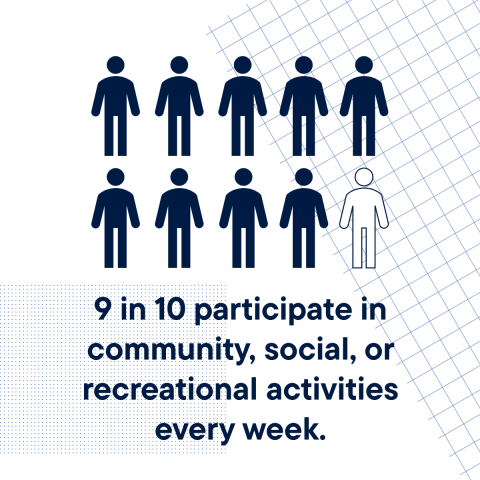
Being involved in community activities, events, and social spaces can support mental health by helping people feel connected and included. The majority of the individuals surveyed (87.5%) reported participating in community or social recreational activities at least weekly, while a small group reported participating only a few times a month. Similarly, 74% of respondents said they feel at least somewhat included in their community, while a smaller group reported feeling less connected or included. These findings suggest that many respondents experience regular community engagement and a sense of belonging.
Access to Transportation
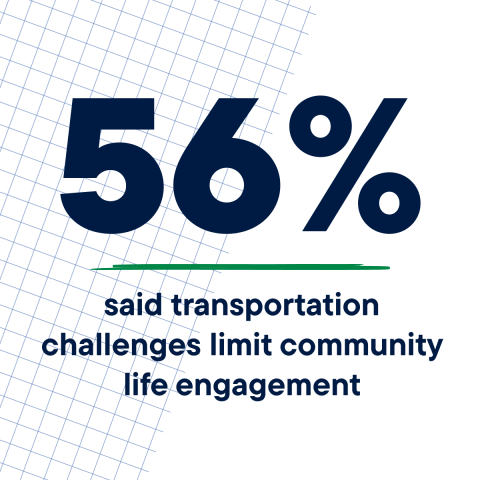
Transportation can affect a person’s ability to attend appointments, participate in activities, and maintain social connections. More than half of respondents (56%) reported that transportation challenges limit their ability to participate in community or social activities at least occasionally, while a slightly smaller group said transportation never limits their participation. These findings suggest that transportation remains a barrier to community involvement for many respondents.
Access to Care
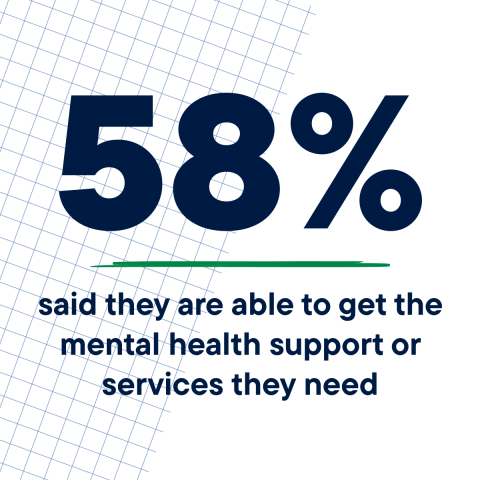
Access to mental health services and supports is an important part of overall well-being. Just over half of survey respondents (58%) reported they are able to get the mental health support or services they need, while a smaller group reported only somewhat being able to access support. Very few said they do not need mental health support services. These findings suggest that many respondents are able to access care, though some barriers to support may still exist.
Facilitators for Mental Health
Survey respondents described a wide range of supports and activities that help them maintain their mental health. Common themes include having strong personal support systems, participating in community activities, staying physically active, and receiving counseling or other mental health services. Respondents also emphasized the importance of routines, understanding from others, and connections with people who share similar experiences. These responses highlight that both formal support and everyday social connections play an important role in supporting mental well-being.
"I engage in active physical activities as much as I can, such as riding bikes, walking, and jumping on my trampoline.”
– New Hampshire resident with a disability.
Barriers to Mental Health
Survey respondents identified several barriers to getting the mental health support they need. A common theme in responses was difficulty finding providers who understand the needs of people with intellectual and developmental disabilities (IDD). Respondents also described challenges related to insurance coverage and long waitlists for care. Overall, responses suggest that the availability of specialized providers and timely access to services remain significant challenges for many individuals seeking mental health support.
“[I’ve been] on a waiting list. For over a year now.”
– New Hampshire resident with a disability.
Conclusions:
Although survey results show that some adults with disabilities in New Hampshire are engaged in their communities and able to access mental health supports, responses highlighted ongoing barriers related to transportation, insurance coverage, mental health service waitlists, mental health care costs, and provider understanding of disability-related needs. Improving access to affordable, disability-informed support may help address these gaps and strengthen access to care.
For this survey, many participants were connected to organizations that support community involvement. To better understand the broader disability community in New Hampshire, future outreach should include individuals who are less connected to services, community organizations, or social opportunities. Additional assessments could explore how age, disability type, and living arrangements impact mental health outcomes.
Resources
For People with Disabilities
- Find Your Peer Support Agency
Provides face-to-face and telephone peer support, outreach, daily programming, and more. - Find Your Community Mental Health Center
Provides 24-hour emergency services, assessment and evaluation, individual and group therapy, case management, and more. - NAMI New Hampshire Support Groups
Provides in-person and virtual support groups that are facilitated by a trained leader with lived experience.
For Providers
- Responsive Practice
Health professional training that enhances the ability to provide disability-competent care. - National Center for START Services® Training Program
Training and professional development opportunities to improve services for individuals with IDD and mental health needs. - Mental Health and Developmental Disabilities National Training Center
Training opportunities to better serve individuals with developmental disabilities and mental illness.
Data Methodology
This brief report considers the specific issue of access to mental health services for adults with disabilities in New Hampshire.
Findings from this assessment will be used to inform the strategies of the NH Disability and Health Program (DHP) to identify gaps in services and address barriers to accessible and effective mental health care for individuals with disabilities.
The findings in this document come from the authors’ analyses of statewide data and survey input from NH adults with disabilities.
Qualitative data appears throughout this report. We are grateful to the individuals who have shared their stories, as their experiences bring the statistics to life and help illustrate their real-world impact. This study was reviewed and approved by the University of New Hampshire Institutional Review Board (IRB-FY26-148).
Suggested citation: Perry, S., Henly, M., & Pease, H. (2026). Mental Health and Disability Among Adults in New Hampshire. University of New Hampshire. Institute on Disability: Durham, NH.
For questions about the study, please contact the New Hampshire Disability and Health program team.
References:
- Centers for Disease Control and Prevention. (2022). Disability and Health Data System (DHDS). Centers for Disease Control and Prevention. https://dhds.cdc.gov/SP
- Komenda-Schned, S., Landskron, S. J., Moritz, P., Brunevskaya, N., Santambrogio, J., Salvador-Carulla, L., Lueger-Schuster, B., & Zeilinger, E.L. (2024). Good mental health in people with intellectual disabilities: A systemic review. Health Psychology Review, 18(4), 954-976. https://doi.org/10.1080/17437199.2024.2398021
- Wang, K., Ostrove, J. M., Manning, R. B., Fodero, S., Ash, S. L., Whang, J., Bogart, K. R., Cipollina, R., Nario-Redmond, M. R., Adler, J. M., & Lowe, S. R. (2024). Ableism in mental healthcare settings: A qualitative study among U.S. adults with disabilities. SSM - Qualitative Research in Health, 6, 100498. https://doi.org/10.1016/j.ssmqr.2024.100498
Funding Statement
This NH Disability & Health Program report was made possible by cooperative agreement DD000025 from the U.S. Centers for Disease Control and Prevention (CDC). Its contents are solely the responsibility of the authors and do not necessarily represent the official views of the CDC or the U.S. Department of Health and Human Services.
