Katy Stratigos, MD, Lauren R. Charlot, PhD, LICSW , and Andrea Caoili, LCSW, EdD
Overview
There is an extensive body of research in the general population that focuses on the relationship between typical grief, bereavement, and situations in which the process of recovery is prolonged or never reached, culminating in the addition of prolonged grief disorder as a formal diagnosis in DSM-5-TR.1-2 Many clinicians assessing and treating people with intellectual and developmental disabilities (IDD) and autism spectrum disorder (ASD) may not be familiar with this body of work. This chapter will investigate typical bereavement and prolonged grief in people with IDD and outline helpful treatment approaches and resources.
DSM-5 TR Changes of Assessment and Diagnosis and Prolonged Grief
The authors of the DSM-5-TR1 recently added prolonged grief disorder as a formal diagnosis to the DSM. The context for the formal addition of prolonged grief was linked to the COVID-19 pandemic and the resulting death, loss, and grief. The criteria (as summarized from DSM-5-TR below) are clearly different from those of major depressive disorder (MDD), and common, self-resolving grief responses. A person with IDD presenting with prolonged grief should also be assessed for MDD as well and may meet criteria for both.
Prolonged grief diagnosis requires at least 12 months of symptoms following the loss and “is characterized by intense longing/yearning for the deceased person and/or preoccupation with thoughts and memories of the lost person to a clinically significant (i.e., impairing) degree, nearly every day for at least the past month.”3
Criteria for Prolonged Grief Disorder (cited directly from the DSM-5 TR)1
Symptoms include:
- Identity disruption (such as feeling as though part of oneself has died).
- Marked sense of disbelief about the death.
- Avoidance of reminders that the person is dead.
- Intense emotional pain (such as anger, bitterness, sorrow) related to the death.
- Difficulty with reintegration (such as problems engaging with friends, pursuing interests, planning for the future).
- Emotional numbness (absence or marked reduction of emotional experience).
- Feeling that life is meaningless.
- Intense loneliness (feeling alone or detached from others).
- Bereavement lasts longer than might be expected based on social, cultural, or religious norms.
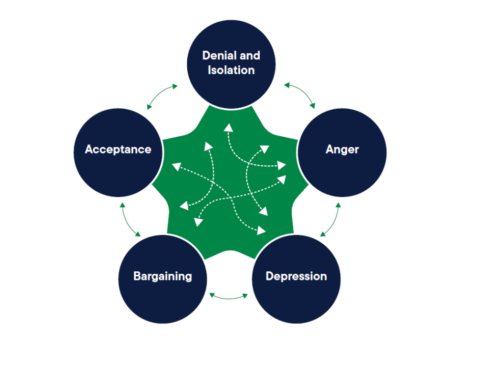
Figure 1: 5 Stages of Grief4,5
Grief Is a Normal Part of Life
Grief as a result of loss is experienced by all people at some point in their lives. A wide variety of losses may impact a person including loss of pets, home, family members, employment, and other things that make up a person’s identity. Kubler-Ross4 developed a five-stage model of grief to describe the various stages and experiences of a person when bereaved. Later, Kessler5 amended the model to include a 6th stage, meaning. People do not follow each stage independently from the other, rather they pass through phases fluidly based on their emotional and physiological state.
Table 1: Six Stage Model of Grief (Kubler-Ross, Kessler)4,5
| Stage | Description |
|---|---|
| Denial | Numbness, "it’s a mistake", false hope |
| Anger | Frustration, irritability, blaming others: “Why me?”, "it’s not fair!" |
| Bargaining | If I only did..., “what if” |
| Depression | Emptiness, feeling overwhelmed, possible suicidal thoughts |
| Acceptance | Emotions stabilize, new reality, more good days than bad |
| Meaning | Finding peace and hope for the future |
Considerations for Patients with IDD
As with other stressful life events, the impact of personal loss may be underestimated in people with IDD. This is at odds with the finding from a meta-analysis that people with IDD are actually likely to experience complicated bereavement at a clinically significant level.6 Access to interventions is undermined by misconceptions that people with IDD do not understand death and need to be “protected” from facing emotional experiences. As a result, people with IDD may not be told of deaths in a timely fashion or not permitted to go to a funeral out of concern they will “get upset.” Even if a person with IDD does not understand the concept of death, one can still experience the emotions of grieving.7 That said, as a result of these biases, people with IDD may not be permitted to grieve with their family, attend funerals or memorial services, or be provided psychological supports to cope with the loss. One poignant response may involve the person waiting or searching for the deceased, not fully understanding that death is irreversible. Such responses may create more distress for other grieving family members as well.6
The other potential complications that implicate misdiagnosis are the underuse of grief counseling and the overuse of ineffective treatments. For example, developmental features can cloud the presentation of a person’s response to loss such that separation anxiety, severe withdrawal, aggression, or self-injury are misattributed to another condition. This mischaracterization can result in the person receiving treatment (including medications to treat different conditions) that are not indicated for grief and thus potentially less effective.
People with IDD have a lifetime of loss and devaluing experiences such as decreased contact and/or inability to live with family, friends, and other natural supports. As life expectancies among those with IDD increase, bereavement around loss of parents is more frequent.7 They may also experience the loss of meaningful work, their home, and housemates, all of which have a significant impact. A major loss like the death of a parent, relative, friend or caregiver occurs in the context of multiple other losses potentially magnifying the impact further. Unrecognized or undiagnosed grief may result in inadequate grief resolution and put the person at greater risk of prolonged grief disorder. In this sense, grief resembles untreated trauma in terms of its transformation into a more complex and difficult to treat disorder.
The grief response for people with IDD can be a complicated process that contributes to a decline in cognitive, social, and emotional presentation. There is a tendency to misattribute many emotional and behavioral features of an evolving grief response to major forms of psychopathology. The expression of grief also follows a developmental trajectory and depends in part on age, cognitive and adaptive abilities, communication skills, and a host of other psychosocial factors, all of which shape a person’s response to loss. In many cases, the expression of externalizing behavioral symptoms overshadows emotional responses, and the recognition of grief as a root cause is under-appreciated. Separation distress symptoms appear to occur more frequently than traumatic grief-type symptoms among people with IDD.8 Reports have described “...developmental slowing or regression motivated by desires to stay connected with the deceased by remaining stuck in the same developmental stage, life circumstances, or immature/self-defeating behavior patterns one was in while they were still alive.”8,2,9 Some common symptoms of grief are described in Table 2. Of note, among the general population, an estimated 80% of people with prolonged grief disorder have impaired sleep long-term.10 While this still needs study among people with IDD, issues with sleep should be considered in a patient presenting with prolonged grief. Alvis and colleagues2 studied the ways in which developmental phenomena impact symptomatic manifestations of complicated grief in youth with a neurotypical developmental history that may provide clues to variable presentations of grief displayed by people with neurodevelopmental disorders. They emphasize the key role of caregivers in grieving.
Table 2: Emotional and Behavioral Symptoms of Grief in IDD11-13
| Emotional Symptoms | Observable Symptoms |
|
|
Effective Psychosocial Treatment Options for People with IDD
The few large-scale scientific studies have not helped to guide many clinicians seeing patients with IDD who experience grief, and in many circumstances, interventions known to be effective with other populations are extrapolated.13,14 For example, preventative or proactive interventions may take advantage of frequent, less extreme situations to help the person learn how to cope with loss and change. These strategies may translate into greater resilience by preparing people for later, more significant losses. Giving the person with IDD choice and opportunities to be part of natural grieving, funerals and other religious and social responses to death is an important and necessary intervention. For bereaved adults with IDD, informal tactics include such activities as an acknowledgment of loss, supportive listening, involvement in rituals, memorialization, bibliotherapy, addressing spiritual beliefs, and life story work along with concrete related activities. Focus on relationships, coping mechanisms, and training for and coordination with residential group home staff has been helpful. Group supports and planned activities may also be effective, including visits to funeral homes, making memory tables, memory boxes, and “comfort bags.” For some, concrete memorializing is especially helpful.
Bereavement counseling can benefit people with IDD, including the full range of levels of severity, regardless of the length of time since death. There are adapted, manualized grief counseling resources available. Formalized complicated grief therapy15,16 remains validated in people with IDD. It is a 16-session treatment intervention including the understanding of grief, managing emotions, finding a promising future, relationship building, telling the story of the death, learning to live with reminders, and connecting memories with the deceased.
When Bereavement Requires Psychopharmacological Intervention
Psychopharmacological intervention may be beneficial when the bereaved person with IDD meets the criteria for clinical depression, has significant impairment in daily functioning, and/or is experiencing suicidal ideation. Anti-depressant treatment does not seem to treat the core symptoms of prolonged grief per se but will address related depressive and anxiety symptoms and has resulted in higher grief-focused therapy completion rates.17
Vignette
George was a 60-year-old man with mild ID and autism. George lived at home with his younger brother and parents for his entire childhood. His mother homeschooled him for multiple years during his school years. George’s immediate family has always been remarkably close and involved in caring for and supporting George. His father died when he was 16 years old, and his brother moved out of the family home when he went to college. Thereafter, George and his mother lived together for many years until his mother died when he was in his mid-50’s. At that time, George moved to a group home for people with IDD. Before moving to the group home, George attended a day program 5 days per week. He also received occasional weekend respite and was involved in his church. Upon moving to the group home, new service providers needed to be established.
Although he still had some support from his brother, the brother did not live in the same state.
George was referred for psychiatric assessment at an IDD specialty service due to “aggressive behaviors,” limiting his day program to only twice/week. His sleep was disrupted, resulting in him waking in the middle of the night often. He appeared irritable and would cry frequently. Upon assessment and symptom tracking, it was noted that George often spoke about his childhood and his family. When he did speak of his parents and his “old life,” as he called it, he would cry. This often led to self-injury (hitting himself on the head, chest, and thighs), yelling and property destruction. Occasionally, it escalated to physical aggression toward others.
Taking symptom trends into consideration, it was determined that a diagnosis of prolonged grief disorder should be considered. In-home support was coordinated with the group home to provide them with additional assistance. Given related symptoms of depression, George began a trial of an SSRI and was enrolled in bereavement focused psychotherapy. Sadly, George passed away during the COVID-19 pandemic. In remembering him, his team of clinicians fondly recalled how he loved to visit a particular hot dog restaurant in Brooklyn where he used to go with his family. George was the inspiration for this team’s interest in loss and grief in IDD, and his contribution is much appreciated, culminating in this chapter.
References
- American Psychiatric Association. Diagnostic and Statistical Manual of Mental Disorders, 5th ed, Text Revision. Washington, DC: American Psychiatric Association; 2022.
- Alvis L, Zhang N, Sandler IN, Kaplow JB. Developmental manifestations of grief in children and adolescents: Caregivers as key grief facilitators. J Child Adolesc Trauma. 2023;16(2):447-457.
- Prigerson HG, Shear MK, Reynolds CF. Prolonged Grief Disorder Diagnostic Criteria—Helping Those with Maladaptive Grief Responses. JAMA.
- Bonell-Pascual E, Huline-Dickens S, Hollins S. Bereavement and grief in adults with learning disabilities: A follow-up study. Br J Psychiatry. 1999;175(4):348-350.
- Kübler-Ross E. On Death and Dying. New York, NY: Collier Books/Macmillan; 1969.
- Kessler D. Finding Meaning: The Sixth Stage of Grief. New York, NY: Scribner; 2019.
- O’Riordan D, Boland G, Guerin S, Dodd P. Synthesising existing research on complicated grief in intellectual disability: findings from a systematic review. J Intellect Disabil Res. 2022 Nov;66(11):833-852.
- Lonergan A. A narrative review of cognitive behavioural therapy in supporting bereaved adults with intellectual disability. Br J Learn Disabil. 2020; 48:190-198.
- Dodd P, McEvoy J, Lockhart K, Burke T, O’Keeffe L, Guerin S. An exploratory study of selfreported complicated grief symptoms in parentally bereaved adults with intellectual disability. J Intellect Disabil Res. 2021;65(4):297-305.
- Layne CM, Kaplow JB, Oosterhoff B, Hill RM, Pynoos SP. The interplay between posttraumatic stress and grief reactions in traumatically bereaved adolescents: When trauma, bereavement, and adolescence converge. Adolescent Psychiatry. 2017;7(4):266-285.
- Szuhany KL, Malgaroli M, Miron CD, Simon NM. Prolonged grief disorder: Course, diagnosis, assessment, and treatment. Focus (Am Psychiatr Publ). 2021 Jun;19(2):161-172.
- Brickell C, Munir K. Grief and its complications in individuals with intellectual disability. Harv Rev Psychiatry. 2008;16(1):10-12.
- Clements P, Focht-New G, Faulkner M. Grief in the shadows: Exploring loss and bereavement in people with developmental disabilities. Issues Ment Health Nurs. 2004;25:799-808.
- Fletcher RJ, Barnhill J, Cooper S-A, editors. Diagnostic Manual-Intellectual Disability: A Textbook of Diagnosis of Mental Disorders in Persons With Intellectual Disability. Kingston, NY: NADD Press; 2017.
- Clute MA. Bereavement interventions for adults with intellectual disabilities: What works? Omega (Westport). 2010;61(2):163-177.
- Dowling S, Hubert J, White S, Hollins S. Bereaved adults with intellectual disabilities: A combined randomized controlled trial and qualitative study of two community-based interventions. J Intellect Disabil Res. 2006;50(4):277-287.
- Shear K, Frank E, Houck PR, Reynolds CF 3rd. Treatment of complicated grief: A randomized controlled trial. JAMA. 2005 Jun 1;293(21):2601-2608.
- Van Dyke L. Lessons in Grief & Death: Supporting People With Developmental Disabilities in the Healing Process. Homewood, IL: High Tide Press; 2013.
