Jennifer McLaren, MD; Jarrett Barnhill MD, DFAPA, FAACAP; Steve Erickson PharmD; Angela Hassiotis, PhD
Overview
People with IDD are vulnerable to high-risk prescribing practices such as polypharmacy or the overuse of antipsychotics.1,2 Polypharmacy, often defined as the use of 5 to 10 or more medications in a person’s regimen, affects 11% to 60% of people with IDD.3-5
Appropriate Versus Problematic Polypharmacy
Appropriate polypharmacy: “the use of multiple medications that are clinically indicated, optimized, and prescribed according to best evidence. They extend life expectancy and improve quality of life for the patient.”6
Problematic polypharmacy: the use of medicines that are no longer appropriate, overuse of high-risk medications (e.g. second-generation antipsychotics, or anti-epileptics in absence of a seizure disorder), the benefits do not outweigh harm, combinations cause or risk harm and usage become unmanageable or distressing.
- Prescribing cascade: adding additional, potentially avoidable medications to drug regimens, often without dropping an existing medication or reducing a dose.7
- This commonly occurs with psychotropic medications and people with IDD.8-9
- Polypharmacy with psychotropic medication leads to an increase in adverse events and drug interactions that negatively affect quality of life.9-11
Factors Contributing to Polypharmacy
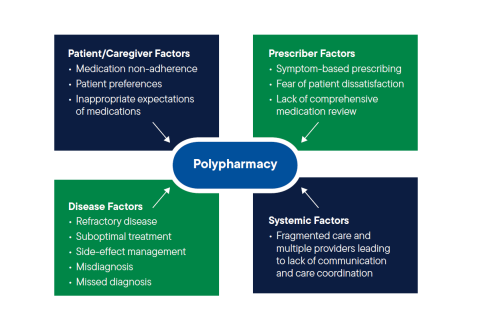
There are many factors that can contribute to polypharmacy. It is important to understand these factors and how they relate to the patient you are caring for; Figure 1 illustrates these factors.
Figure 1: Contributing Factors to Polypharmacy12
Risks and Consequences of Polypharmacy
Patients treated with polypharmacy are at increased risks that prescribers should consider. Health risks are summarized in Table 1, while additional risks are detailed in Tables 2 and 3.
Table 1: Health Risks Associated with Polypharmacy
| Health Risks | Examples of High Risks with These Medications or Combination of These Medications | Consequences |
|---|---|---|
| Metabolic Side Effects |
| Obesity, hyperlipidemia, and diabetes |
| Seizures |
| Decrease in seizure threshold |
| Cardiac |
| QTC prolongation and arrhythmias |
| Clozapine and benzodiazepines | Myocarditis, hypotension, cardiac arrest | |
| SSRIs and beta blockers | Bradycardia and hypotension | |
| Antipsychotics and TCAs | Tachycardia, orthostatic hypotension, QT prolongation | |
| Lithium and diuretics/NSAIDS/ACE Inhibitors | Bradycardia and T wave changes | |
| Akathisia |
| Increased restlessness, irritability, or agitation |
| Extrapyramidal Symptoms |
| Parkinsonism, dystonia, tardive dyskinesia, or neuroleptic malignant syndrome |
| Liver Injury |
| Mild enzyme elevations, severe hepatoxicity, to acute liver failure |
| Constipation |
| Constipation or decreased gastrointestinal motility |
| Sedation |
| In people with IDD, sedative effects may be more significant and increase risk of falls, cognitive impairment, and reduced functioning. |
Table 2: Quality of Life Risks with Polypharmacy
| Quality of Life Risks | Consequences |
|---|---|
| Financial | Increased costs due to multiple medications or may limit access to needed medications. |
| Time | Increased time picking up and managing medications and monitoring. |
| Physical Health | Potential decline in physical health. |
| Daily Functioning and Cognitive Functioning | Potential decline in physical and cognitive functioning. |
Table 3: Prescribing and Administration Risks with Polypharmacy
| Prescribing and Administration Risks | Consequences |
|---|---|
| Prescribing Errors | Can lead to inappropriate drugs being prescribed, increasing risk of side effects or adverse reactions. |
| Dosing Errors | Incorrect dose can lead to ineffective treatment or toxicity. |
| Mistakes in Taking or Administering Medications | Complex medication regimens increase the risk of patient or caregiver errors. |
| Potential Difficulties with Monitoring | Harder to track benefits and side effects of medication when multiple medications are prescribed. |
Appropriate Prescribing
It is imperative that the prescribing of psychotropic medication to people with IDD is aligned with evidence-based prescribing practices and is guided by clinical practice guidelines. Guidelines help ensure that patients receive treatments that are most appropriate for their care.
- OPTIMA-ID (Optimizing pharmaco-therapy and improving medication for ageing with intellectual disability) is a guide to optimization of medication regimens for older adults with intellectual disability, developed by healthcare providers as well as persons with intellectual disability.13
- Twenty-two of the 67 criteria in OPTIMA-ID focus on psychotropic medications. Incorporating education and training with implementation of guidelines is another approach to working to ensure appropriate prescribing of psychotropic medications.
- STOMP initiative (Stopping over-medication of people with intellectual disability, autism, or both -STOMP), was developed as an intervention to improve the prescribing of psychotropic medications taken by persons with ID living in the United Kingdom.
- Implementation of the STOMP initiative has led to increased awareness of prescribing practices of psychotropic medications for persons with ID in the UK.14
It is important for clinicians and caregivers to investigate physical, environmental, and social factors when challenging behaviors are present, which may respond to non-medication approaches such as cognitive behavior therapy and positive behavior support.15 Because of the adverse effect profile of psychotropics, and antipsychotics, the decision to use these medications as an intervention for challenging behavior should be carefully rationalized.16,17
Key Steps in Deprescribing Psychotropic Medications18
- Obtain a complete list of all the medications that the patient is taking and the reason for each medication.
- Understand the effect of the medication on the patient (e.g., if it was helpful or not, if it has caused side effects and what side effects).
- Conduct a complete evaluation of the patient, including a thorough understanding of what is going well and what is not going well in their life.
- Full review of systems
- Obtain any indicated measurements: e.g., BMI, labs, rating scales, etc.
- Develop a crisis/safety plan.
- Understand why the patient was put on polypharmacy (coordinate with other prescribers and have an interdisciplinary approach).
- Consider each medication’s potential benefits against its potential risks or burdens, both now and in the future.
- Provide psychoeducation to patients and caregivers and/or guardians about polypharmacy, the potential benefits, and the potential risks. Consider deprescribing with patient and caregiver and/or guardian.
- Discuss the pros and cons of deprescribing
- Consider deprescribing the medication with the lowest benefit or lowest risk of withdrawal or medication that is causing side effects.
- Slowly taper the medication and closely monitor.
- Most medications should be slowly tapered in a systematic and stepwise approach (e.g.,
10-25% of dose every 2-4 weeks until discontinuation). - Some medications (e.g., stimulants) can be discontinued without a taper).
- Use rating scales to monitor the underlying condition the medication was intended to treat (e.g., aberrant behavior checklist for behaviors that challenge).
- Consider more frequent visits to check on the patient for improvement or side effects.
Conclusion
Polypharmacy is a common and concerning practice for people with IDD. While some cases of polypharmacy are appropriate, many involve inappropriate prescribing practices that can lead to adverse outcomes. Thoughtful, evidence-based prescribing is important, and active deprescribing of unnecessary medications is also a particularly important intervention.
References
- Marquis S, Marquis NE, Lunsky Y, McGrail KM, Baumbusch J. Prescriptions for antipsychotics: youth with intellectual/developmental disabilities compared to youth without intellectual/developmental disabilities. J Autism Dev Disord. 2024. doi:10.1007/s10803-024-06344-z.
- McLaren JL, Lichtenstein JD, Metcalfe JD, Charlot LR, Drake RE, Beasley JB. Psychotropic use among youths with intellectual and developmental disabilities. Psychiatr Serv (Washington, D.C.). 2021;72(9):988-997. doi:10.1176/appi.ps.201900465.
- Stortz JN, Lake JK, Cobigo V, Ouellette-Kuntz HM, Lunsky Y. Lessons learned from our elders: how to study polypharmacy in populations with intellectual and developmental disabilities. Ment Retard. 2014;52(1):60-77.
- Haider SI, Ansari Z, Vaughan L, Matters H, Emerson E. Prevalence and factors associated with polypharmacy in Victorian adults with intellectual disability. Res Dev Disabil. 2014;35(11):3071-3080.
- McMahon M, Hatton C, Bowring DL. Polypharmacy and psychotropic polypharmacy in adults with intellectual disability: a cross-sectional total population study. J Intellect Disabil Res. 2020;64(11):834-851.
- Specialist Pharmacy Service. Understanding polypharmacy, overprescribing and deprescribing. 2025. Accessed September 2025. https://www.sps.nhs.uk/articles/understanding-polypharmacy-overprescrib…
- Rochon PA, Gurwitz JH. The prescribing cascade revisited. Lancet. 2017;389(10081):1778-1780.
- McGillivray JA, McCabe MP. Pharmacological management of challenging behavior of individuals with intellectual disability. Res Dev Disabil. 2004;25(6):523-537.
- O’Dwyer M, Peklar J, McCallion P, McCarron M, Henman MC. Factors associated with polypharmacy and excessive polypharmacy in older people with intellectual disability differ from the general population: a cross-sectional observational nationwide study. BMJ Open. 2016;6(4):e010505.
- Erickson SR, Jones JL, Gallus KL, Esler A, Houseworth J. Potential drug interactions in medication regimens of adults who have intellectual and developmental disabilities. J Dev Phys Disabil. 2022;34:1-34.
- Scheifes A, Walraven S, Stolker JJ, Nijman HL, Egberts TC, Heerdink ER. Adverse events and the relation with quality of life in adults with intellectual disability and challenging behavior using psychotropic drugs. Res Dev Disabil. 2016;49:13-21.
- Freudenreich O, Kontos N, Querques J. Psychiatric polypharmacy: a clinical approach based on etiology and differential diagnosis. Harv Rev Psychiatry. 2012;20(2):79-85. doi:10.3109/10673229.2012.677358.
- O’Connell J, Gorman A, Burke É, Deb S, Henman MC, McCallion P, et al. OPTIMA-ID: development and validation of a medicine optimization tool for older adults with intellectual disability. Expert Rev Clin Pharmacol. 2024;17(9):837-851.
- Branford D, Gerrard D, Saleem N, Shaw C, Webster A. Stopping over-medication of people with an intellectual disability, autism or both (STOMP) in England part 2–the story so far. Adv Ment Health Intellect Disabil. 2019;13(1):41-51.
- Song M, Rubin BS, Ha JW, Ware RS, Doan TN, Harley D. Use of psychotropic medications in adults with intellectual disability: a systematic review and meta-analysis. Aust N Z J Psychiatry. 2023;57(5):661-674.
- Barnhill J. Integrated pharmacological management. In: Rubin I, Merrick J, Greydanus D, Patel D, eds. Health Care for People With Intellectual and Developmental Disabilities Across the Lifespan, 3rd ed. New York, NY: Springer; 2016:1601-1615.
- Costello A, Hudson E, Morrissey S, Sharma D, Kelly D, Doody O. Management of psychotropic medications in adults with intellectual disability: a scoping review. Ann Med. 2022;54(1):2485-2498.
- Scott IA, Hilmer SN, Reeve E, Potter K, Le Couteur D, Rigby D, et al. Reducing inappropriate polypharmacy: the process of deprescribing. JAMA Intern Med. 2015;175(5):827-834.
