Director’s Introduction
This year, the Institute on Disability continued to accelerate disability inclusion through education, research, and collaboration. Our work is rooted in a simple but powerful belief: when communities embrace everyone, they are stronger, more resilient, and more innovative.
From classrooms to community programs, we opened doors to opportunity by designing learning experiences that equip people to thrive and systems to respond. Our research generated knowledge that not only deepens understanding but also drives smarter policy and more responsive services. And through partnerships across sectors, we co-created solutions that improve access, strengthen supports, and expand opportunities.
The results are tangible: thousands of professionals trained, new leaders prepared, groundbreaking studies published, and initiatives launched that help people live, learn, and participate in their communities.
As you read this report, I invite you to see more than numbers and milestones. See the people — students, families, providers, and advocates — who make this work possible. Their stories remind us that our mission is not just a goal but a movement, and together we are shaping a future where everyone belongs.
Sincerely,

Andrew Houtenville
Director, Institute on Disability
Impact Story
A new model of care

“LEND made me dream and design this type of practice," Dr. Plotnik says. "It helped me see the need, verbalize it, and bring it to my administration."
Dr. Lisa Plotnik, a graduate of a NH-ME Leadership Education in Neurodevelopmental and Related Disabilities (NH-ME LEND), is blazing a new trail in primary care for New Hampshire families, placing individuals and their loved ones at the center of an innovative approach designed to ease the transition from pediatric to adult care for patients with chronic illness or disability. Through her innovative wraparound primary care model, she and her team provide specialized care that puts the individual with chronic illness or disability and their family at the center — ensuring that the entire family’s perspective and needs are taken into consideration.
“I was seeing how many families couldn’t get their own health care,” Plotnik explains. “They didn’t have time; they didn’t have the bandwidth. And so we were taking care of emergencies that happened around our patient because their family couldn’t get the care they needed.”
That realization became the foundation for what is now a thriving department that serves children and adults with complex medical and behavioral needs in New Hampshire. By integrating family members and caregivers into the care plan, whether in-person or through telehealth, Plotnik’s clinic helps prevent crises before they occur. The result is a model that not only supports better health outcomes but also aims to preserve stability and dignity.
Education that opens doors
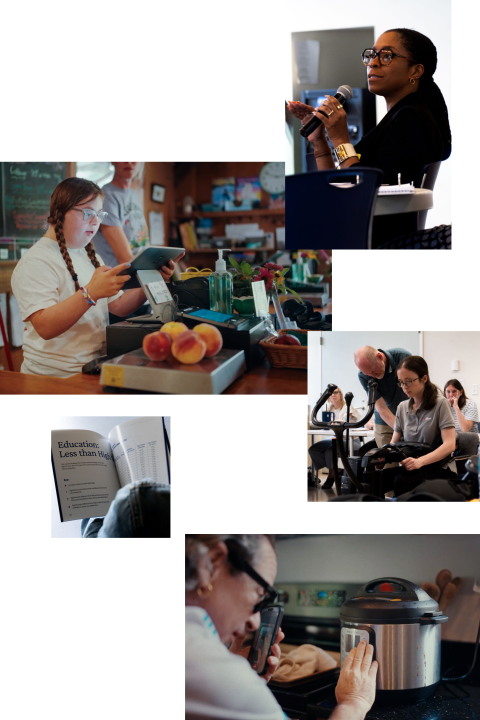
Education opens doors to opportunity, contribution, and lifelong growth. At the IOD, we design learning experiences that equip people with tools to thrive and systems to respond. From university programs to customized training, our approach is grounded in universal design and informed by people with lived experience.
When learning is accessible, practical, and built for everyone, it transforms lives and communities.
Fiscal Year Highlights

Trained START programs across the country who fielded 3,200+ crisis calls for people with IDD-MH with 84% of crisis responses resulted in people remaining in their homes and communities.
Certified 47 crisis responders, strengthening New Hampshire’s mobile crisis teams.
Trained over 100 peers and paraprofessionals to address behavioral health needs of children and families impacted by substance use.
Graduated the 1,100th participant of the NH Leadership Series, preparing advocates to influence schools, workplaces, and communities across NH.
Equipped 2,352 healthcare professionals and students to deliver more inclusive preventive care.


Assistive Technology in New Hampshire
Our ATinNH program played a vital role this year in helping students access and engage with learning in ways that match their unique strengths and needs. Our work this year helped support success across every subject — from reading and math to art, music, and physical education.
Research that strengthens systems
Our research is designed to inform action. We investigate real-world questions, generate practical knowledge, and work with communities to translate findings into meaningful change.
We’re focused on what research makes possible: smarter policy, more responsive services, and a deeper understanding of how to create systems that work for everyone. Through every study, we aim to promote full participation, reduce barriers, and expand opportunities.

State House Visit
New Hampshire Leadership Series Concord, NH | March, 2025
Fiscal Year Highlights
- Discovered that rural Americans face steep barriers accessing Social Security services.
(Brucker et al., 2025) - Surveyed supervisors in the hospitality industry and revealed critical insights into the recruitment, support, and accommodation of workers with disabilities. (Kessler, 2024)
- Found that more than half of NH employers are unprepared for new lactation law requirements.
(Yang et al., 2025) - Partnered with Georgetown and Brandeis to create a first-of-its-kind doula toolkit to improve maternal care for women with IDD.
- Published research showing SNAP participation does not improve food security for working-age adults with disabilities. (Brucker, Kim, et al., 2025)

-
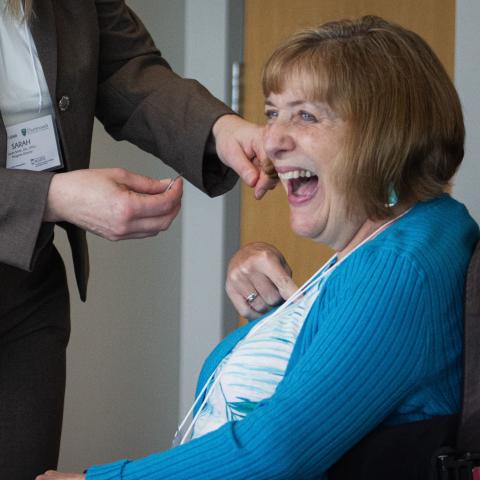
“I always say, it’s a good idea to become an expert on yourself. This way, you can be your own best advocate if you need help in any area of life. I give the same advice to anyone with a disability, regardless of how visible the disability may appear to others.”
Kathy Bates,
Ask Kathy: Live Proud

Impact Story
Championing inclusion through leadership and action
“I have met so many people through these wonderful organizations that share the goal that I have… That’s to give back to the community and help people with disabilities, like myself, have a better life.” — Tim Houle

One in eight New Hampshire residents, 13.2%, lives with a disability. While New Hampshire consistently reports higher education and employment rates for people with disabilities than the national average, barriers to inclusion remain. Nearly one in five Granite Staters with disabilities still live in poverty, and employment rates lag almost 37 percentage points behind those without disabilities. These numbers reveal both progress and urgency for leadership, collaboration, and change across our state.
Few embody that spirit more than Tim Houle. Living with cerebral palsy, Tim has turned his lived experience into a powerful force for positive change. In 2025, Tim received the NH Leadership Annie Forts Award, honoring his leadership, advocacy, and deep commitment to community. Known for his warmth, humor, and openness, Tim is a connector — someone who builds belonging wherever he goes. Whether mentoring new advocates, participating in workgroups, or helping others navigate barriers in employment and transportation, Tim’s leadership reflects a simple but powerful truth: communities are strongest when they embrace everyone.
For Tim, advocacy is personal. “Life for people with disabilities is hard enough,” he says. “We shouldn’t have to worry about lack of transportation, employment, or accessibility.”
Through leaders like Tim, the IOD’s mission comes to life, and his story reminds us that belonging is not a luxury; it’s a basic human need.
Collaborating for powerful change
We believe that communities are strongest when they embrace everyone. That’s why we partner across sectors and communities to create solutions that are effective, sustainable, and inclusive by design.
Whether supporting agencies, advising policymakers, or training professionals, our collaborations are built on trust, shared learning, and a commitment to improving access for all.
Fiscal Year Highlights
- Drove 28 statewide, cross-sector initiatives improving health access for adults with IDD and mobility disabilities.
- Conducted 162 on-site reviews across NH to uphold choice, control, and everyday community life for people receiving Home and Community Based Services (HCBS).
- Partnered with 30+ stakeholders in NH and ME to improve services for people with neurodevelopmental disabilities.
- Convened 100+ advocates through the Advocate NH Conference and Disability Justice Parade.

Helped Granite Staters regain independence by refurbishing, reassigning, or loaning 3,363 assistive technology devices.

-

LEND Training Director Stacy Driscoll congratulates Ivy Foster with Sarah Smith and Marnie Morneault watching.

NH-ME LEND 2026 Capstone Graduation
Trainees celebrated their capstone work this year by showcasing leadership and partnerships they developed to strengthen disability services across New Hampshire and Maine.
By the Numbers
Measuring impact
* Asterisks indicate an all-time high.
| Item | FY 2025 |
|---|---|
| Foundation & Non-Profit Grants | $1,905,701.15* |
| Training & Consulting Agreements | $5,427,133.00 |
| State Grants & Contracts | $1,951,157.86 |
| Federal Grants | $6,071,202.24 |
| Other Non-Grant Revenue | $213,654.00 |
| Gifts | $432,984.08* |
| Total Budget | $16,001,832.33 |


Our team
Full-time (74)
Principal Investigators (20)
- Tenure-track (2)
- Research faculty (6)
- Senior staff (12)
Staff (52)
- Salaried (41)
- Hourly (11)
Post-Doctoral Fellows (2)
Part-time (30)
- Staff (21)
- Students (9)
Delivering impact across CHHS
As part of the College of Health and Human Services (CHHS), the Institute on Disability brings the college’s strategic pillars to life to ensure the well-being of individuals, families, and communities across New Hampshire and beyond.
Innovative education and training:
2,352 professionals and students trained to deliver more inclusive preventive care.
Leading-edge research:
21 peer-reviewed articles published advancing knowledge and policy.
Interprofessional collaboration:
9,820 hours of disability-related technical assistance delivered to 9,999 recipients nationwide
Community engagement and partnerships:
28 cross-sector state initiatives improving health access for adults with IDD and mobility disabilities.
Together, this work reflects UNH’s commitment to strengthening our state and its communities.