What’s new for voters with disabilities in New Hampshire?
You might think it's wild, but I really love voting season! It's much more than endless campaign flyers packed in the mailbox, candidates bad-mouthing each other, and making promises they can't keep. In this post, I will discuss what's new for voters with disabilities in New Hampshire and why participation matters. My vote matters to me because it connects me to my community, and I care enough about community issues to want my vote counted. The disability community talks about inclusion all the time, but to be included, we have to participate.
Before we jump into what's new, let's take a step back and look at some very encouraging statistics from the last presidential election. According to a report from the Disability Research Program at Rutgers, 154 million ballots were cast in the November 2024 election, including 20 million by voters with disabilities. One in six eligible voters, or 40.2 million people, has a disability. That is a 5.1% increase since 2020, double the 2.5% rise for voters without disabilities. The research shows that voter turnout increases when the process is more accessible. So why does this matter? The number of voters with disabilities is increasing faster than the number of voters without disabilities; the voter turnout gap between the two groups is closing, but non-disabled voters still vote at a higher rate.
As a voting bloc, the disability community has an opportunity to be heard.
Imagine how accessible our cities and towns could be if the disability community voted at the same rate as non-disabled voters.
What's new?
Disability Rights Toolkit 2nd edition
The Disability Rights Center New Hampshire created the Know Your Rights Toolkit for Voters with Disabilities (second edition) so voters with disabilities can participate fully in the voting process. The Toolkit has been expanded this year with three new sections that cover a range of things related to a new law, technology, and resources, which I’ll touch on below.
Applying to vote by absentee ballot
You can call your town or city clerk and ask them to mail you an application or download one and print it out. Although there is no deadline to request an absentee ballot, you should do it as soon as possible to ensure you have plenty of time to fill it out and send it back. New Hampshire law States that all absentee ballot applications must be verified. This means you have to prove you are eligible to vote before the clerk can send you an absentee ballot.
You can have your application notarized. The DRC will do it for free if you call and make an appointment. 603- 228- 0432
You can also mail a copy of your photo ID with your application or show it to the clerk in person at the clerk’s office along with your application.
A more accessible way to vote
The OMNI Ballot has arrived at a polling place near you! Democracy Live, a company well known for designing voting equipment, developed the new system. It will replace the One for All voting system. This system will allow voters with a wide range of disabilities to vote privately and independently.
The ballot marking system includes a large touch-screen tablet, screen reader, headphones, and an HP printer. Voters can fill out their ballots using new options. They can use a Nav pad, which allows users to write on the ballot with Braille arrow keys and includes three large buttons for voters who can't use the smaller ones. To ensure privacy, your voting information will never be online, and when your ballot is printed, it will look like everyone else's.
The OMNI Ballot is accessible and secure; any voter can use it; a disability is not required. In fact, it's a good idea to try the OMNI Ballot even if you don't identify as disabled; maybe you have a friend or family member who will be eligible to vote in the future and will need to use the voting machine. Don't forget to share your experience with them or, better yet, bring them along. It will be a great learning experience.
Icon-based voting requests
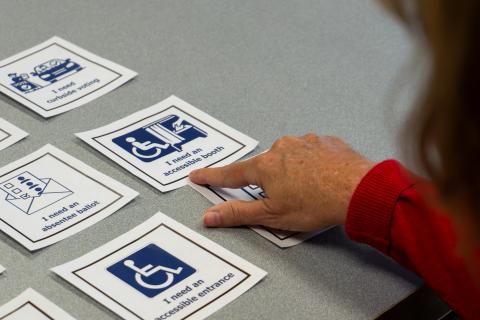
Voters with communication challenges now have a new way to ask for help at the polls. A list of common voting requests is shown as icons with words that make clear what kind of assistance is needed and can be found in the voter toolkit. The list was created by Angela Fletcher with the support of the NH Leadership Series education team and in partnership with Disability Rights Center-NH, Institute on Disability at UNH, and the NH Council on Developmental Disabilities. Users can print out and bring the Icon-Based Voting Requests flyer with them to the polls at nhcdd.nh.gov.
From Where I Sit
Okay, I'm sure you know by now; I'm a big fan of voting. And it's not just because it is my constitutional right and my civic duty, although that is part of it. I like to vote in person because I like to see all my neighbors, and I want them to see me. Representation matters.
Those of us who need support to get through even the basic routine of our day understand that having a disability means we have fewer choices in life than someone who is not disabled, and privacy and independence can be hard to achieve. This is not a complaint; it's a fact. When I vote, it’s my right to do it privately and independently just like everyone else.
Voting in the primary was so easy, and it only took a few minutes. That is a beautiful thing!
Every vote counts! New Hampshire’s midterm election is November 3rd, 2026.
If you feel your rights have been violated or you have an accessibility issue at the polls, you can call the Disability Rights Center's election day hotline and talk with a lawyer free of charge at 603-410-5200.
Author(s)


