Shining a Light on Vision Loss
I will eventually lose my sight due to macular degeneration. What services are available for people with progressive vision loss, and when is the best time to start preparing for the inevitable? Do some states offer more services than others?
Thank you, Jetta Darrow
I'm sure you understand by now that you are not alone in this diagnosis. In fact, age-related macular degeneration (AMD) is the leading cause of blindness in people over 50. After a little research, I learned that the macula is a small, oval-shaped area at the back of the retina that enables us to see color and detailed images directly in front of us. The retina and the macula work together to convert light into images that the brain interprets. AMD affects the ability to recognize faces, use digital technology, drive, and read.
Since I don't have lived experience with AMD, I spoke with my favorite expert on the subject, my Aunt Connie. She is 91 years young and was diagnosed with the disease when she was 65. She ran Little Folks kindergarten and preschool out of her home, where she taught for 40 years before retiring at 72. She then worked at Target for six more years. My aunt has a lot of energy.
Here is part of our conversation:
Aunt Connie, what can you see?
“I can see lights and shadows. I can't see your face at all, but I know it's you because I recognize your voice. When my Macula was damaged, straight lines became wavy, and my vision became blurry. I still have my peripheral (side) vision, which is not usually affected by AMD.”
Where do you get services, and what kind of services do you get?
“I get all my services from Future Insight. My eye doctor gave me a referral letter, so now I qualify for transportation services. A volunteer can take me to my appointments or to visit a friend.
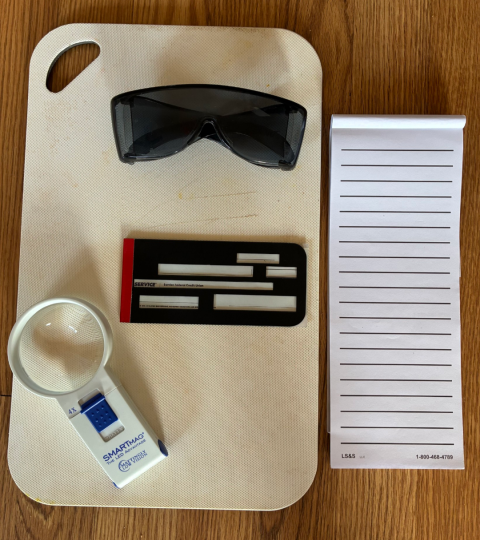
When I first became a client, someone came to my house and gave me an eye exam to evaluate my vision loss, just like when you go to the eye doctor. The next step was to talk about the things I was having trouble with. I could no longer read the messages on my cell phone, so Karen helped me enlarge the words. Between that and my high-power magnifying glass, I can read my messages.
She might suggest some new technology for me to try. I told them I could not see faces on TV, so now I use these TV binoculars. They can be adjusted so that I can see more detail. I can see the birds outside when I look out my window.
I really like to cook. My friends and I make treats for each other. I have a cutting board that is black on one side and white on the other. Most of the time I can see the food I am cutting best on the black side. I use red sticky dots near the knobs on my stove to turn on my burners. My Alexa can help me read the directions on shiny packages because I can't do that at all.”
Do you have any advice for people newly diagnosed with progressive vision loss?
“Yes, I think it would be important to start preparing ASAP, because it will be easier to learn how to use new technology when you have more of your sight.”
Helpful services
Support and services for people diagnosed with progressive macular degeneration will most likely include a team of medical professionals who specialize in low vision or blindness. An occupational therapist can help you learn to use your peripheral, or side, vision more effectively, and do many of the things you want to do. They can also suggest different ways to set up your living environment to maximize safety and independence. An Assistive Technology Specialist will help you learn to use various tools, such as magnifiers and screen readers, to make the most of your vision. A certified orientation and mobility Specialist can help you learn to navigate your home and community safely with confidence. Counseling and/or peer support may prove invaluable as you face the challenges of your vision loss.
When we are talking about disability services a state provides, more is not necessarily better. It all comes down to money. Generally, the bigger the state, the more money there is for disability services and accessible transportation systems. But money is not the only factor; what services do you need or want?
For example, cities such as Washington, DC; Louisville, Kentucky; Chapel Hill, North Carolina; and Seattle, Washington are very walkable and have well-organized transit systems.
New Hampshire, Massachusetts, Montana, and Maine are often the highest-ranking states for providing educational Services to students with visual impairments. With specialized programs, a strong teacher-to-student ratio, and effective vocational rehabilitation services, New Hampshire leads the nation in the overall employment rate of people with visual disabilities, at 98.6 percent.
Colorado and California have a large network of state agencies, high accessibility standards, and high employment rates for individuals with disabilities.
Several organizations in New Hampshire offer services to people who are visually impaired or blind. Here are a few to consider:
- Future Insight offers volunteer transportation services, daily living skills training, and technology support.
- Independent Living Services for Older Individuals who are blind (LI-OIB) focuses on helping people who are blind and fifty-five or older build independent living skills.
- American Foundation for the Blind (AFB) Focuses on expanding opportunity for the blind and visually impaired through research, education, and advocacy.
- Getting Started Guide- Navigating Life with Vision Loss helps those who are newly diagnosed—I like them a lot.
Just a little advice... find a community; it is one thing to say you're not alone, but it's another thing to feel it. Disability is never anything to be ashamed of, but it does change your relationship with your body, so it's okay to be angry sometimes. It’s easier to process your experience when you have a strong support network around you.
Author(s)


