Inclusive Approaches to Healthcare

Advancing more inclusive healthcare
Adults with intellectual and developmental disabilities (IDD) deserve healthcare that recognizes their needs, respects their experiences, and supports their overall well-being. This project works to improve how healthcare professionals deliver care to adults with IDD by strengthening clinical guidance and expanding opportunities for education and advocacy.
Through updated treatment guidance and training opportunities, this project helps ensure that healthcare providers have the knowledge, tools, and resources they need to deliver inclusive, person-centered care.
About the project
This initiative focuses on improving healthcare outcomes for adults with intellectual and developmental disabilities by:
- Updating the Integrated Mental Health Treatment Guidelines for Prescribers in Intellectual and Developmental Disabilities, an important resource used by healthcare providers.
- Training physicians and healthcare professionals to support more inclusive and effective care.
- Expanding advocacy training opportunities for people with intellectual and developmental disabilities through the New Hampshire Leadership Series (NHLS).
Together, these efforts help build a healthcare system that is more responsive, accessible, and inclusive.
Who this work supports
By equipping both professionals and advocates with knowledge and tools, the project strengthens collaboration across healthcare systems and communities.
More specifically this project is designed to support:
- Healthcare professionals, including physicians and prescribers working with adults with intellectual and developmental disabilities
- Healthcare educators and trainers implementing professional learning opportunities
- Advocates and leaders with intellectual and developmental disabilities participating in leadership and advocacy training
Project materials and resources
The project will produce a collection of educational resources to support inclusive healthcare practices. These materials are designed to help professionals implement evidence-informed approaches to care for adults with intellectual and developmental disabilities.
Resources may include:
- Integrated Mental Health Treatment Guidelines for Prescribers in Intellectual and Developmental Disabilities Second Edition
- Educational and training materials for healthcare professionals
- Leading the Way to Our Own Health, a healthcare advocacy training program by and for adults with intellectual and developmental disabilities
As materials become available, they will be shared here to support learning and implementation across healthcare settings.
Presentations
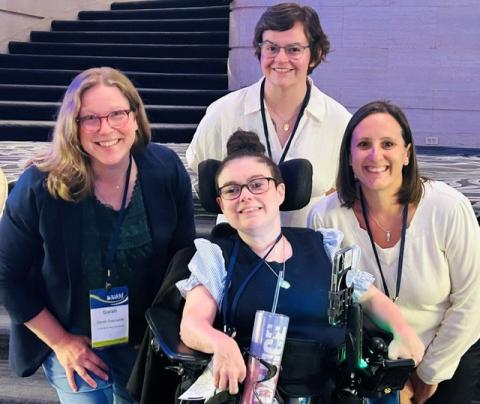
Project team members attend the 2026 Annual Conference for the American Association on Intellectual and Developmental Disabilities. Pictured here are Jess Martin, Andrea Palmieri, Micah Peace Urquilla, and Sarah Sadowski.
Project Team
This project is led by the Institute on Disability at the University of New Hampshire with contributions from a multidisciplinary team.
Project staff include:
To learn more about leadership and advocacy opportunities connected to this work, visit the New Hampshire Leadership Series.
Project Contributors
People with lived experience, advocates, and professionals play an essential role in shaping more inclusive healthcare. The contributors below bring diverse perspectives that help strengthen the project’s resources and training materials.
Destiny Watkins
Destiny Watkins lives in Post Falls, Idaho, where she is raising her son Jamesun, who has complex medical needs. Through her experiences as a parent and advocate, Destiny is continually learning alongside Jamesun and working to better understand and support his needs. She brings her perspective to a range of advocacy efforts focused on improving systems for people with disabilities and their families.
Reflecting on her experience with this project, Destiny shares: “I like how supportive everyone is and how everyone works off each other and how positive the time is with all the obstacles we all have and challenges. I like being in research, there is positive change in our health care systems due to it.”
Tim Houle
Tim Houle lives in Kingston, New Hampshire, and is the former Chair of the New Hampshire Council on Developmental Disabilities. He works at Goodwill and is particularly interested in issues related to mental health and employment for people with disabilities.
Tim values the collaborative nature of the workgroup and the thoughtful discussions that help move the project forward.
Oscar Segal
Oscar Segal lives in New York City and is a filmmaker with an interest in disability rights and supported decision making as an alternative to guardianship. Through his creative work and advocacy, Oscar explores ways to promote autonomy, dignity, and self-determination for people with disabilities.
Amanda Stahl
Amanda Stahl is a licensed social worker trained in trauma-based therapy and Eye Movement Desensitization and Reprocessing (EMDR). She has worked in the field of developmental disabilities for more than a decade and brings clinical expertise and trauma-informed perspectives to the project.
Jess Martin
Jess Martin is a disability advocate from Chicago, Illinois, and a university student majoring in human services and disability studies. Jess is also a dancer and choreographer.
They value the opportunity to learn while contributing to work that helps others. Participating in the project has also supported Jess’s long-term goal of building a career in disability advocacy and disability studies.
Nathaniel Lentz
Nathaniel Lentz is from Madison, Wisconsin, where he serves as Director of Outreach and Advocacy for The Arc of Dane County. Nathaniel is interested in policy as a tool for improving the lives of people with disabilities.
He has enjoyed collaborating with other advocates on the project and bringing together diverse perspectives to strengthen the work.
